Depolarization Field and Size Effect in Ferroelectric Thin Films
©️ Copyright 2025 @ Liu Theory Lab
Author:
Tianyuan Zhu
Date:2025-10-15
Lisence:This document is licensed under Attribution-NonCommercial-ShareAlike 4.0 International (CC BY-NC-SA 4.0) license.
1. Depolarization fields under different electrical boundary conditions
For a typical ferroelectric thin film, the polarization surface charges give rise to a depolarization field antiparallel to the polarization, thereby tending to suppress the out-of-plane polarization. The magnitude of this field depends critically on the electrical boundary conditions.
Under the open-circuit condition, i.e., in the absence of electrode screening (Fig. 1a), the depolarization field is given by
where \(P\) and \(\epsilon\) denote the polarization and dielectric permittivity, respectively.
In contrast, when the polarization surface charges are perfectly screened by ideal metallic electrodes (Fig. 1b), the depolarization field vanishes:
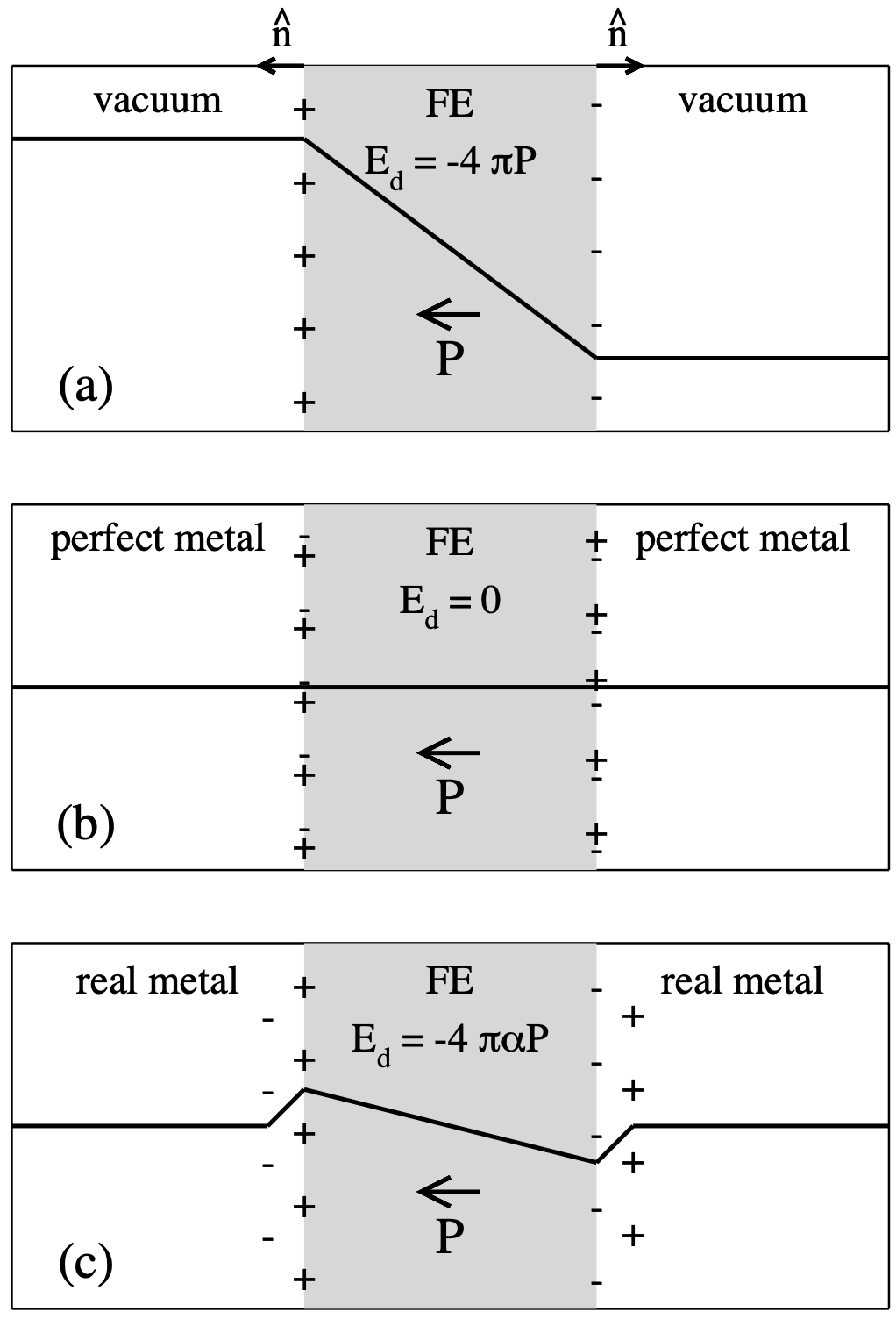
Figure 1. Depolarization field of a ferroelectric slab under different electrical boundary conditions. (a) No screening. (b) Perfect screening. (c) Imperfect screening. Extracted from Ref. [1].
In realistic systems (Fig. 1c and Fig. 2), the compensating charges provided by the electrodes are displaced from the ferroelectric–electrode interface by a distance \(\lambda\), referred to as the effective screening length, resulting in incomplete screening of the polarization surface charges. The corresponding depolarization field arises from both the polarization surface charges and the compensating charges:
where \(d\) is the film thickness. In the limit of vanishing effective screening length (\(\lambda \rightarrow 0\)), the depolarization field disappears, recovering the perfect screening condition. Unlike the two limiting cases discussed above (no screening and perfect screening), where the depolarization field is independent of film thickness, under imperfect screening the depolarization field increases as the film thickness decreases.
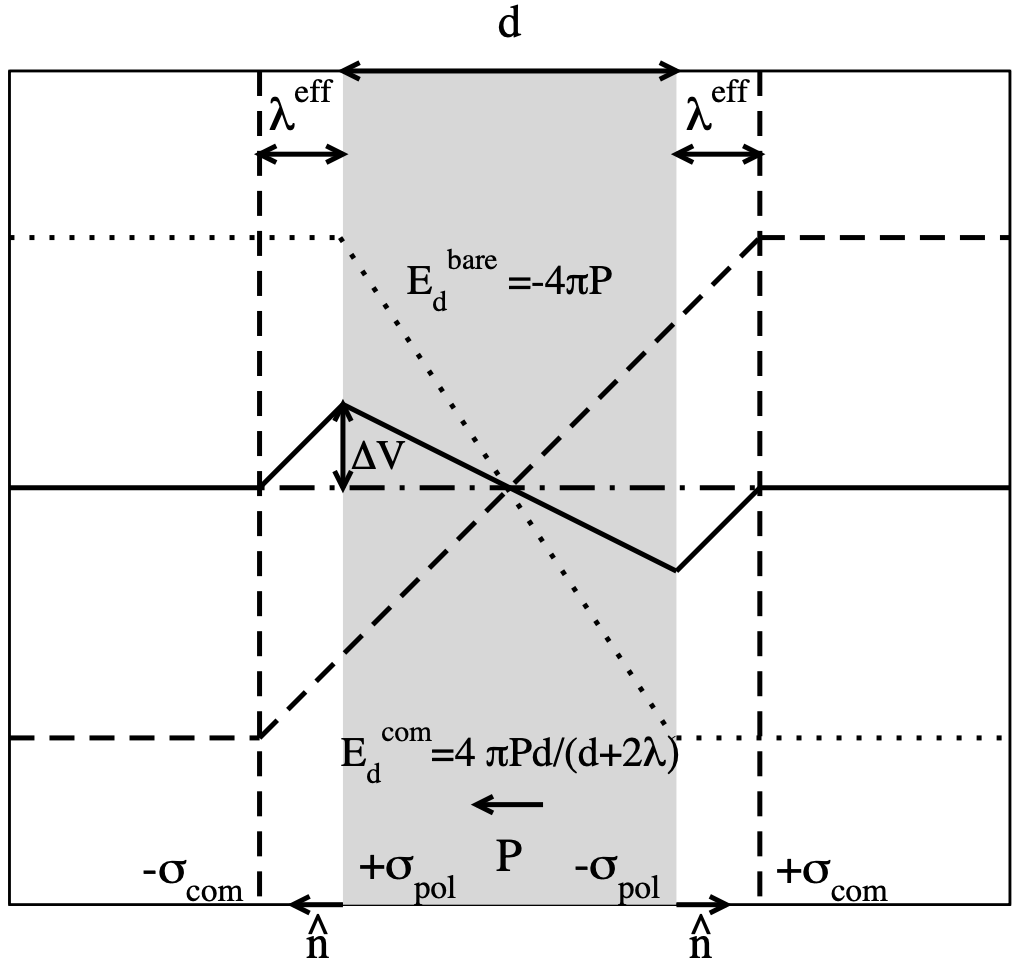
Figure 2. Depolarization field of an imperfectly-screened ferroelectric slab. Extracted from Ref. [1].
2. Depolarization-induced size effect: Critical thickness for ferroelectricity
Within the framework of imperfect screening, the depolarization field becomes stronger as the film thickness decreases, giving rise to a critical thickness below which the polarization disappears. The total energy of the ferroelectric thin film is given by
where the first term represents the bulk unit-cell energy and the second term accounts for the depolarization energy penalty. \(P\) is the polarization, \(\Omega\) the unit-cell volume, and \(\mathcal{E}_{\rm d}=-\frac{2P\lambda}{\epsilon d}\) is the depolarization field under imperfect screening.
As the film thickness \(d\) decreases to a critical thickness, the depolarization energy penalty increases and eventually overwhelms the intrinsic bulk double-well potential, resulting in the suppression of polarization.
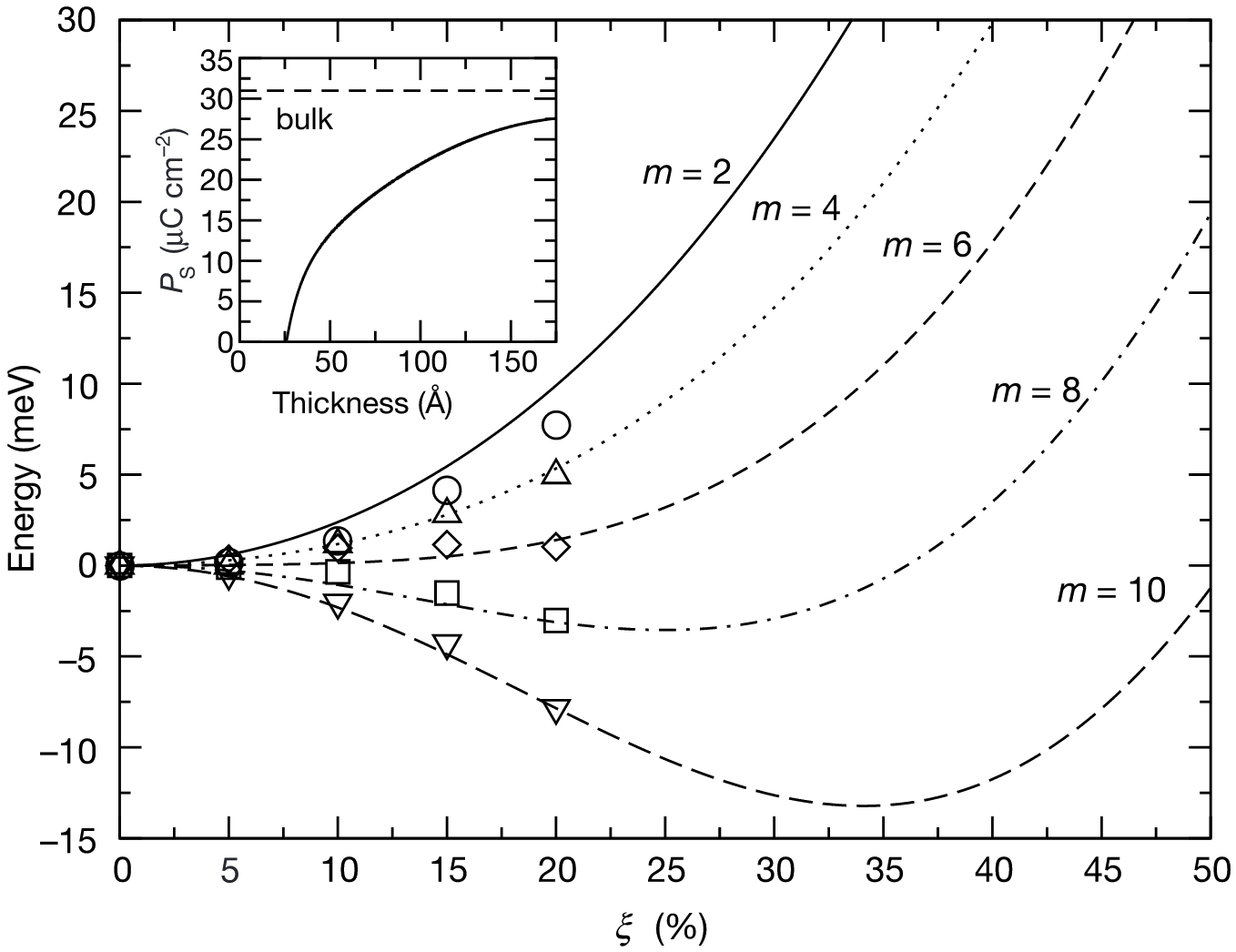
Figure 3. Evolution of the energy as a function of the ferroelectric distortion for thin films of different thicknesses ($m$, in unit cells). Inset shows the evolution of the spontaneous polarization with thickness, which dispears at a critical thickness of approximately six unit cells ($m$=6, $d$=24 Å). Extracted from Ref. [2].
References
[1] Philippe Ghosez and Javier Junquera, First-Principles Modeling of Ferroelectric Oxides Nanostructures, (2006).
[2] Javier Junquera and Philippe Ghosez, Critical thickness for ferroelectricity in perovskite ultrathin films, Nature 422, 506 (2003).